

The Modern CHRO: Episode 3
How the CHRO Role Has Transformed: From Policies to Platforms
Over the last several years, the role of the Chief Human Resources Officer (CHRO) has undergone one of its most significant evolutions to date. What was once a function centered on policies, programs, and annual cycles has rapidly shifted into a discipline that looks—and operates—much more like product management, data science, and strategic value creation.
In our conversation with leading HR experts, a clear theme emerged: today’s CHRO isn’t just an HR leader. They’re a builder, a strategist, and a data translator for the boardroom.
Listen to Episode 3: “The Evolution of the Role” HERE
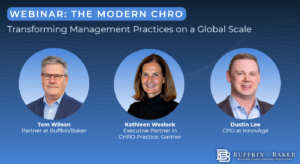
Partner Tom Wilson interviews two HR Executive experts to discuss their perspectives on the evolving role. Our panel includes:
- Dustin Lee, Chief People Officer, Innovage
- Kathleen Weslock, Executive Partner in CHRO Practice, Gartner
From Programs to Products
One of the most striking shifts is the move from traditional HR programs to HR “products.” Modern HR teams are building career frameworks, learning stacks, and analytics tools—often on shared enterprise platforms rather than in organizational silos. This “product mindset” mirrors how software teams operate, focusing on iteration, scale, and measurable impact.
A New Focus on Productivity and Value
Engagement scores alone no longer cut it. CHROs are now expected to show how talent decisions impact productivity, financial metrics, and organizational risk. Talent strategies are becoming deeply tied to value creation, with HR leaders increasingly asked to demonstrate cost–benefit causality to boards and executive teams.
Agile HR Becomes the Norm
Borrowing from software development, many HR teams are adopting sprint-based operating rhythms. Instead of annual planning cycles, organizations are shifting to shorter cadences—quarterly workforce reallocations, continuous talent assessment, and an “always‑on” approach to workforce intelligence. While common in tech, this is newer in sectors like healthcare, which are now embracing agile principles to keep up with industry shifts and acquisitions.
Boards Want More, and Better, People Analytics
Perhaps the most surprising change is the board’s growing appetite for deeper, more rigorous people insights. HR leaders who can connect talent moves to strategic outcomes are increasingly setting the agenda. As one expert put it, the maturity of people analytics has reached a point where boards expect CHROs to bring data-driven clarity, not just intuition.
Cross-Industry Thinking Is Now a Must
With board members who sit across multiple industries, CHROs are under pressure to import best practices from everywhere—not just their own sector. Whether navigating nontraditional acquisitions or building new talent models, HR leaders who draw from diverse industry experience are better equipped to guide their organizations through complexity and change.
Why These Differences Matter in the Future of HR
As industries evolve, so do the expectations placed on CHROs. Adaptable, thoughtful HR leadership can drive impact in any environment. It also highlights why the next generation of CHROs must be equally comfortable with people strategy, business economics, and organizational design.
To learn more about our HR functional practice, click here.
Follow our LinkedIn to stay up to date.