

The Modern CHRO Episode 7: Redesigning the CHRO Role from Scratch
Listen to Episode 7: “Redesigning The CHRO Role from Scratch” HERE
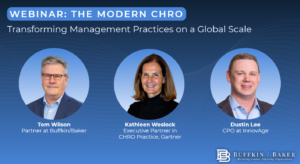
Partner Tom Wilson interviews two HR Executive experts to discuss their perspectives on the evolving role. Our panel includes:
- Dustin Lee, Chief People Officer, Innovage
- Kathleen Weslock, Executive Partner in CHRO Practice, Gartner
Ask ten leaders what HR should be, and you will get ten different answers. Everyone has a picture of the function. Few of those pictures match.
So Tom Wilson asked a simple question. If you could redesign the CHRO role from scratch, what would you change about how it is structured or what it is meant to achieve?
Kathleen Weslock started her answer at the beginning.
The Roots of the Function
HR began as personnel. Before that, roles within HR were often divided by gender. Weslock saw this firsthand early in her career.
She started in labor relations, where few women worked at the time. To negotiate a strong contract, she knew she had to understand benefits. So she moved into the benefits world.
There she was steered toward what she calls the “pink collar” side of the work. That meant retirement calculations and Form 5500 filings. She did not stay there. She moved into designing and costing benefits and planning for how benefits would change in the future. Those harder skills helped her career along the way.
Her point is simple. How HR started still shapes how people see it today.
The Paradox of HR
Weslock calls it the paradox of HR. Everyone has a view of what the function should be.
Some leaders want HR to be loved. Others want it to be feared. She has heard both while interviewing for roles. Her answer to each is the same. She is neither. HR lives somewhere between Doris Day and Cruella De Vil.
Many of these views come from fiction, old assumptions, and past experience. That makes great HR hard to define. In many cases, you only see what it looks like once you are in the role.
“Anybody Can Do HR”
Tom pointed out a belief he hears often. Anyone can do HR.
Weslock disagreed. The work is technical. Few people outside the function know what a Form 5500 is, for example.
She compared the CHRO to the conductor of an orchestra. The CHRO leads many instruments and many functions. Some call for left-brain thinking. Others call for right-brain thinking. Some call for heart. If you have never sat in those chairs, you cannot tell whether you are hearing music or noise.
Know What Great Looks Like
For Weslock, the answer is experience across the whole function. She learned the trade by sitting in every seat.
That is the lesson for anyone redesigning the role. A CHRO has to know what great looks like in each part of HR before they can lead all of it.
To learn more about our HR functional practice, click here.
Follow our LinkedIn to stay up to date on new thought leadership.